
Quality Control Stamps: Conforming/Non-Conforming, Approved and Traceability

Anyone who works in quality knows that most of the job doesn't happen on a computer screen, it happens on an inspection sheet clipped to a board, next to a production line or a goods receiving area. That's where a well-designed stamp saves seconds that, multiplied by hundreds of records a week, add up to hours.
The problem is that searching online for this kind of stamp usually turns up one of two things: generic red "approved" stamps that look like presentation clipart, or nothing specific to the real process of a factory or warehouse. This article is about the stamps a quality and production team actually uses, and how to have them custom-made for your company's exact process.

Why paper still survives in a world of digital systems
It's a fair question: with ERPs, digital quality management systems and barcode scanners everywhere, why does a receiving sheet still travel from clipboard to clipboard? There are concrete reasons. In an ISO audit, the auditor wants to see physical evidence that the inspection happened at the moment it happened, not a record entered into the system half an hour later from memory (fresh or otherwise). In production environments with dust, oil, or humidity, a tablet or a thermal printer suffers a lot more than a sheet of paper and a stamp. And there's the speed factor too: for someone inspecting a part every thirty seconds on a line, opening a system, picking the right field, and saving is slower than reaching for a stamp.
That's why, even in companies with advanced digital systems, the stamp still has a place, usually as the first layer of record-keeping, before the information gets entered into the system.
Quality control stamps, stage by stage
Incoming goods and supplier inspection
The first control point in any production chain, whether it's food, metalworking, textiles or pharmaceuticals. A typical receiving sheet has several fields to confirm at once, and a stamp with checkboxes, to mark with a cross, handles that in a single motion:
Quantity matches the delivery note: Pass / Fail
Labeling correct: Pass / Fail
Shelf life within accepted range: Pass / Fail
Packaging integrity: Pass / Fail
Certificate of analysis attached, yes or no
Approved supplier or supplier under review

In-process inspection
Along the line, the check is no longer about what came in, it's about what's coming out right now:
Visual inspection: Pass / Fail
Dimensional inspection: Pass / Fail
First article inspection approved
Retained sample, with space for batch and date
Process parameters within spec: Pass / Fail
Packaging and shipping
The last checkpoint before the product leaves the factory or warehouse, where a mistake costs far more to fix than it would earlier in the process:
Quantity matches: Pass / Fail
Ready to ship or on hold
Pallet complete or incomplete
Final inspection before shipping: Pass / Fail
Non-conformances and quarantine
The moment something has failed and needs to be flagged clearly, so no one mistakenly lets it move forward:
Product in quarantine
Under investigation
Rejected, with space to indicate the outcome: rework, return, or scrap
Corrective action opened
Traceability: batch, date and serial number
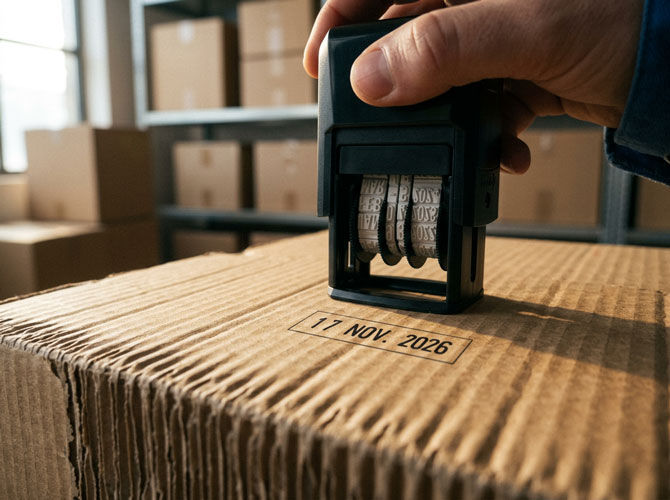
This is where a product we already make, and that somehow flies under the radar, comes in: automatic date and number stamps, built exactly for this. The date stamp prints the full date (day, month, year) with a rotating mechanism you adjust on the spot, no new printing needed every time the day changes. The number stamp does the same with rotating digits, ideal for sequential batch or document numbering. Both have built-in self-inking, made to handle repeated use through an entire shift without losing sharpness.
Batch no.
Manufacturing date and expiry date
Serial number
Documentation and audits
For anyone managing a quality management system and dealing with document control, the challenge is different: making sure no one is working from the wrong version of a procedure:
Controlled copy or uncontrolled copy
Obsolete document
Reviewed by / Approved by, with space for date and initials
Equipment maintenance and calibration
Equipment calibrated, with space to note the next calibration date
Equipment out of service
No two companies run quality the same way, and the stamp should follow suit
The list above covers the most requested models, but it would be impossible to list every possible combination, because every company ends up developing its own terminology and its own fields over the years. An automotive parts factory doesn't track the same fields as a pharmaceutical warehouse, and that's fine: send us the exact text, fields, and checkboxes your process already uses on paper, and we'll replicate it in stamp form. You don't need to adapt your process to a generic template.
Which model to choose?
On a production line or receiving area where a stamp might pass through several hands dozens of times a shift, the self-inking (automatic) stamp is the right choice: built-in ink, no loose pad to lose or dry out, and a high-definition rubber base that keeps printing sharply even after thousands of uses.
For stamps used less often, like document audits or equipment calibration, a traditional stamp with a separate ink pad remains a valid, more affordable option.
How to order
Send us the text and layout you need, including the fields, checkboxes, and exact order that make sense for your process, and you'll always get a free mockup to approve before we move to production. We ship internationally.
If your department needs several stamps for different stages of the process, receiving, inspection, shipping, and non-conformance, for example, combine them into a single order: it works out cheaper per unit and arrives all at once, saving you the hassle of coordinating separate orders for each workstation.
Frequently asked questions
Can you make a stamp with checkboxes to mark pass/fail? Yes, it's one of the most requested formats from quality teams. We always send a mockup so you can confirm the exact layout, including checkbox size, before production.
Can you make custom stamps for my company's specific process, even if it's not on this list? Yes. The models described above are the most common, but not the only ones possible. Send us the text and fields you currently use on paper and we'll adapt the design to match.
Does a stamp replace a barcode system for traceability? No, and that's not the intent. For automated traceability with a unique serial number per unit, a barcode system remains the right tool. A stamp works well as a fast, first layer of record-keeping on paper, without depending on a printer, network, or software.
Do you work with companies that have a certified quality management system, like ISO 9001? Yes, several of our production and logistics customers use this type of stamp as part of their day-to-day document control.
Is it worth ordering several stamps at once for my department? Yes, both for the per-unit cost and for the convenience of having everything ready at once, instead of placing separate orders every time a workstation runs out of a stamp.
Comments